Python: The Language That Redefined Modern Technology (Complete Guide 2026)
If there is a language that can be called "omnipresent" in today's technological landscape, that language is Python. From Cisco routers to Netflix recommendation algorithms, Python is everywhere. But how did a language created by a single man as a holiday project reach this level?
In this exhaustive guide, we will dive into the history, the technique, and the future of the language that every IT student, especially those focused on Cybersecurity and Development, needs to master.
1. Genesis: The Birth of a Giant
Who created Python?
Python was conceived by Guido van Rossum, a Dutch programmer. In the late 80s, Guido was known in the community as a brilliant developer working at the CWI (Centrum Wiskunde & Informatica) in the Netherlands.
Where and When?
Unlike languages created in large American corporate laboratories (such as C or Java), Python was born in the Netherlands. Guido began implementation in December 1989. He was looking for a project to keep himself occupied during the Christmas break when the lab was closed. Version 0.9.0 was published in February 1991.
Why was Python created?
Guido was working with a language called ABC, which was excellent for teaching but lacked in operating system interaction. He wanted something that inherited ABC's readability but was capable of handling exceptions and interacting with the Amoeba operating system (a distributed system project at the time).
The name, as a technical curiosity, is not a tribute to the reptile. Guido was a fan of the British comedy group Monty Python's Flying Circus. He wanted a name that was short, unique, and slightly irreverent.
2. Philosophy and Architecture: The "Zen of Python"
The secret to Python's success lies not just in what it does, but in how it does it. The language was built under the concept of PEP 20 (Python Enhancement Proposal), known as the Zen of Python.
Some of the pillars you should know:
- Readability above all: "Code is read more often than it is written."
- Simplicity: If the implementation is hard to explain, it's a bad idea.
- Explicit is better than implicit: Avoid "magic" that the programmer doesn't understand.
3. Utility and Ecosystem: What is Python for?
Currently, Python is a general-purpose language. This means it is not limited to one niche. At Malieda Hub, we explore the three verticals where it shines most:
A. Data Science and Artificial Intelligence
Python is the undisputed king here. Thanks to libraries like Pandas, NumPy, and Scikit-Learn, data scientists can manipulate massive amounts of information with just a few lines of code. For AI, PyTorch and TensorFlow are the pillars of the generative revolution we are living today.
B. Cybersecurity and Network Automation
For those studying Cisco, Python is the "NetDevOps" tool. Instead of configuring 100 switches manually, you write a Python script using the Netmiko or NAPALM library for automated deployment. In security, it is used to create vulnerability scanners and pentest automation.
C. Web Development (Backend)
Frameworks like Django (robust and secure) and FastAPI (extremely fast and modern) allow for the creation of complex APIs in record time.
4. Technical Analysis: Pros and Cons
Advantages (Pros)
- Friendly Syntax: The learning curve is the smoothest on the market.
- Productivity: What takes 50 lines in C++, takes 5 in Python.
- Vast Standard Library: The "Batteries Included" concept means it comes ready to use.
- Community: Massive support in forums and open-source libraries.
Disadvantages (Cons)
- Execution Speed: As an interpreted language, it is slower than compiled languages like C or Rust.
- Memory Consumption: Python requires more hardware to process large volumes of data natively.
- Mobile Development: It is still not a strong native choice for Android or iOS.
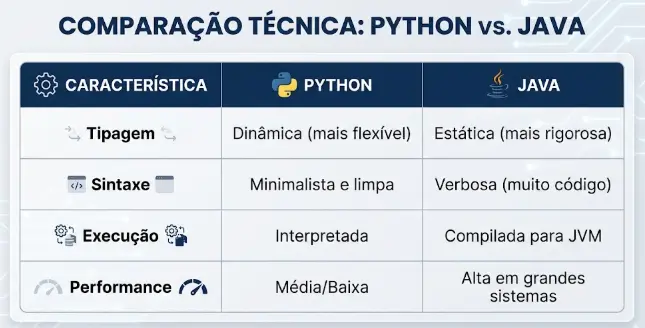
5. The Great Clash: Python vs. Java
6. Practical Guide: Preparing the Elite Environment
Installation on Windows vs. Linux
On Windows, the safest path is to download the official installer from python.org. Check the "Add Python to PATH" box; this allows you to call the interpreter directly from the terminal. On Linux, Python usually comes pre-installed. To update, we use the command: sudo apt update && sudo apt install python3-pip.
The Power of Virtual Environments (venv)
A common beginner mistake is installing libraries globally. At Malieda, we recommend virtual environments. By running python -m venv my_project, you create an isolated "bubble," avoiding conflicts that could break your operating system.
7. The "Must-Have" Library Ecosystem
- Requests (Web Automation): Essential for interacting with APIs and websites with human-like commands.
- Pandas (Gold for Finance): Your Excel spreadsheet on steroids for ROI and volatility calculations.
- Scapy (Networks and Cisco): Allows you to "sniff," forge, and send network packets for security testing.
8. Hands-on: Your First Automation Script
Nothing fixes knowledge better than solving a real problem and seeing the code running in the terminal. Below, you can see the logic of an automation script for compound interest calculation — an essential tool for any investor following Malieda.
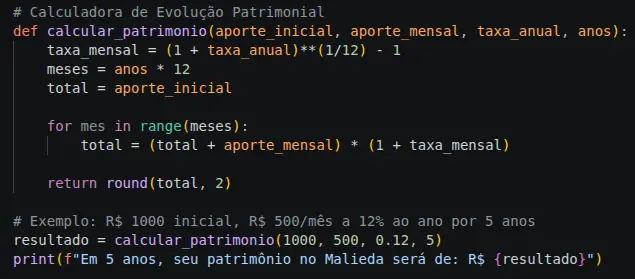 Caption: Explaining the Logic
As you can see in the image above, we use functions (
Caption: Explaining the Logic
As you can see in the image above, we use functions (def) to organize the calculation, loops (for) to simulate the passage of time, and f-strings so that the result appears clearly and professionally in the console.
9. Career and Certifications: How to Prove Your Value?
It's not enough to know how to code; in the 2026 technology market, knowledge validation is what opens doors to the best jobs and selection processes.
The PCEP Certification and the Cisco Opportunity
The PCEP (Certified Entry-Level Python Programmer) certification, from the Python Institute, is the ideal starting point. It focuses on the fundamentals: data types, control structures, collections, and functions.
Malieda's Golden Tip: Few people know, but Cisco Networking Academy offers a completely free preparatory course called "Python Essentials". This course is specifically focused on the entry-level certification exam, covering all necessary content with no cost for teaching materials. It is the perfect opportunity to align networking knowledge with programming.
The Job Market in 2026
The market for Python developers remains hot in three fronts:
- Data Engineering: Where Python is used to organize information flow.
- AI Developer (AI Engineer): Creating integrations between systems and language models.
- SOC/Security Analyst: Automating cyber defense.
10. Python in 2026: The Future is Bright
In 2026, with performance improvements and the explosion of Artificial Intelligence, Python has consolidated itself as the foundation of innovation. Python is the bridge between being an operator and being a solutions architect.
So?
Mastering Python is not just about learning the syntax; it's about learning to think in an automated way. If you want to start, my advice is: stop reading and start coding. Solve a real problem from your daily life using Python. The technology market doesn't reward those who know the theory, but those who deliver results.